The Mountains and Gorges of Crete
Introduction to the Mountains and Gorges of Crete
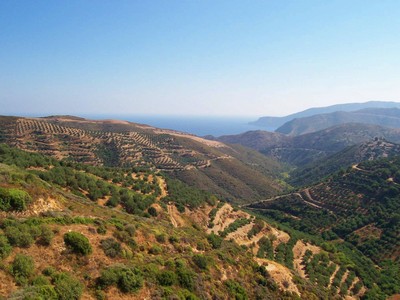
Crete has 3 main mountain ranges, the White Mountains, Mount Ida (Psiloritis) and the Dikti Mountains, and dozens of gorges cut through them. The mountains and gorges of Crete are at their finest on foot, and long walks show off the island's unique plants and wildlife.
Fit and active visitors can go trekking, caving, mountaineering, cycling, climbing and hiking through the ranges, gorges, caves and plateaux. This page draws on our own walks and on reports from the mountain areas.
The Mountains of Crete
Crete is one of the most mountainous islands in Europe, with a chain of high mountains crossing it from west to east in 3 main groups.

The White Mountains
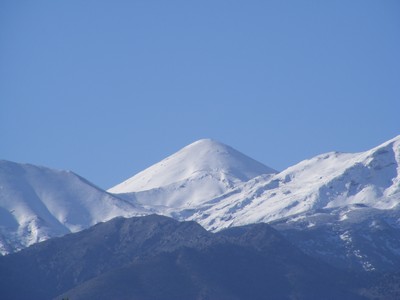
The White Mountains (Lefka Ori) are the backdrop to all of western Crete. They are called the White Mountains less for the snow that lies on them until late spring than for their pale limestone summits, which look white in the sun. Our page on the White Mountains of Crete through the seasons describes the range from Chania.
The White Mountains are the largest of the 3 mountain groups. They divide loosely into eastern, central and western ranges, with more than 20 peaks above 2,000 m, according to the official Visit Greece site. The highest summit, Pachnes (2453m), is only 3m lower than Timios Stavros on Mount Ida.
About 50 gorges cut through the White Mountains, and the Samaria Gorge is the most famous of them. High plateaux lie in the centre of the range. The Omalos Plateau is the most famous of them, a round plain at about 1100m, ringed by mountains.

Mount Ida
Mount Ida or Psiloritis is a single elongated mountain mass whose highest peak is Timios Stavros (2456m) and is the highest point in Crete. West of Knossos and rising above central Crete, Mount Ida is just 3m higher than Pachnes, the highest summit of the White Mountains. Amongst the Mount Ida mountain range are numerous caves, gorges and plateaux.
Mount Ida is where Zeus grew up, according to Greek mythology. The Ideon Andron, or Cave of Zeus, lies on its slopes, a 15-minute walk from the Nida Plateau. Legend says nymphs raised the young god here. Other tales tell how Minos, the King of Crete and a son of Zeus, came to the cave every 9 years to ask his father for help in writing the laws of his kingdom.
The Dikti Mountains
In east Crete is Dikti or the Lassithi Mountains, a range with many peaks, the highest being Spathi at 2148m. The Mount Dikti range and the Lassithi Plateau, which spreads out between the peaks is home to many myths and legends of Greek mythology.
The Psychro Cave, also called the Dikteon Andron, lies on the northern slopes of the Dikti range. Myth names it as the birthplace of Zeus, who was later raised by nymphs on Mount Ida.
The Mountains of Sitia
The Sitia area in the far east of Crete has 2 further large mountain ranges beyond the 3 main groups. These eastern ranges make climbing in Crete very varied.
The Gorges of Crete
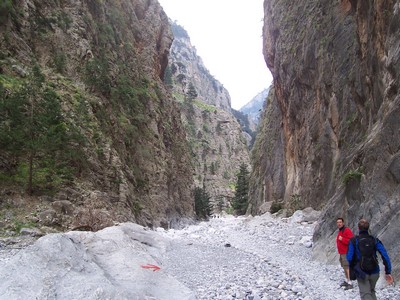
The most famous gorges of Crete are Samaria, Imbros and Agia Irini, all in the White Mountains of Chania. Dozens of smaller gorges cross the rest of the island and suit anyone who enjoys walking, plants and wildlife.


Samaria Gorge
The Samaria Gorge is the most famous gorge in Crete, a walk of about 15 km from Xyloskalo on the Omalos Plateau (1,227 m) down to Agia Roumeli on the Libyan Sea. The Samaria National Park is run by the Natural Environment and Climate Change Agency (NECCA), and these details come from the NECCA Samaria Gorge ticket portal (checked October 2026):
- Season: the park rules allow the gorge to open between 10 April and 31 October, with the exact opening date set each year after path repairs. In 2026 it opened on 19 May.
- Fees: €10 for an individual ticket, €6 per person for families and €8 per person for club groups of more than 10. Under-18s and over-65s enter free.
- Tickets: on sale online through the portal or at the Xyloskalo and Agia Roumeli entrances. Keep the second ticket issued at the entrance, because it is checked at the exit.
- Hours: entry for the full walk is from 07:00 to 13:00, and everyone must be out of the gorge by 18:00.
The gorge closes whenever rain or rock falls make it unsafe. In late October 2026 the portal said the gorge was closed from both entrances until further notice, pending safety inspections, so check the portal before you travel.
We have walked the whole gorge ourselves. Our account of hiking the Samaria Gorge describes the day.
Imbros Gorge
Imbros Gorge (Faragi Imbrou) is a gorge of about 7 km from Imbros village down to Komitades, near Chora Sfakion in Chania, and takes 2 to 3 hours to walk. It is a pleasant and fairly easy walk and, after Samaria, draws the most visitors. NECCA's Imbros Gorge ticket portal (checked October 2026) gives the season as 1 May to 31 October, open daily from 08:00 to 20:00, with an individual ticket at €5.
Imbros Gorge is one of the most beautiful gorges in Crete, with narrow canyon sections and rich flora and fauna. In 1941, during the Battle of Crete, thousands of Allied troops retreated through the gorge from the north of the island. They headed for Chora Sfakion, where ships evacuated them to Egypt.
Agia Irini Gorge
The Agia Irini Gorge (also spelt Ayia Irini) is a wooded gorge about 7.5 km long in the White Mountains of Chania, close to the Samaria Gorge, ending about 5 km from Sougia. It is much less crowded than Samaria, which makes it more appealing to some walkers. The gorge is a section of the E4 European walking path, on the inland route from Sougia to Omalos. A Region of Crete visitor study recorded an entry fee of €2 in 2022 and found the gorge open for a longer season than Samaria.
We walked the Agia Irini Gorge in October 2007, on a day when rain had closed the Samaria Gorge, and really enjoyed it. Our own account of hiking the Agia Irini Gorge tells the story of that day.
Other Crete Gorges
Butterfly Gorge
Butterfly Gorge begins high up on the road to Orino and ends at Koutsouras National Park in the Lassithi region of Crete close to the village of Makriyialos.
Butterfly Gorge takes its name from the huge number of butterflies found there. The walk runs through a valley with abandoned Cretan villages.
Pefki Gorge
Pefki Gorge begins just outside the village of Pefki on the road to Agios Stephanos and ends at Aspros Potamos. Again the Pefki Gorge is found in the Lasithi region of East Crete close to the village of Makrigialos.
Pefki Gorge is a gentle walk. Ancient donkey tracks lead through olive groves and into the gorge, where vertical cliffs rise about 200 metres on either side.
Moni Kapsa
Moni Kapsa Gorge begins at the village of Kato Pervolakia and ends at the Monastery of Kapsa. This gorge is the deepest of all three of the gorges in the Lasithi region of East Crete close to the village of Makrigialos.
Moni Kapsa Gorge is the most challenging of the 3 gorges near Makrigialos. The reward is striking scenery and some of the richest wildlife in the region.
The Gorge of Zakros
The Gorge of Zakros is in the far east of Crete, in Lasithi, and leads down to Kato Zakros, where the E4 path across Crete ends. Our guide to Zakros covers the village and the Minoan palace.
The Gorge of Zakros is also called the Gorge of the Dead. Large caves open in its walls, and tombs from the Minoan period were found inside them, together with finds of great archaeological importance. These burials gave the gorge its name.
When to Walk in the Mountains of Crete
May, June, September and October are the most comfortable months for walking in the mountains of Crete. The winter months are often too wet and windy, and high summer is too hot for long hikes. Snow can stay on the high summits until late spring.
Mountain Huts in Crete
Greek mountaineering clubs maintain several mountain huts in the 3 large mountain ranges of Crete. Hikers on the alpine stretch of the E4 European walking path in Crete use them too. Refuges close to villages are usually open most of the year, while remote huts can stay closed until as late as May.
The mountaineering clubs of Chania, Rethymno, Heraklion and Lasithi look after these 7 huts:
- Kallergi, near the Samaria Gorge in the White Mountains (Chania), open at weekends all year and on other days by arrangement
- Volikas, above Keramia in the White Mountains (Chania)
- Svourichti (Christos Houliopoulos) hut at Katsiveli, below Svourichti in the White Mountains (Chania)
- Tavri, on the Askyfou Plateau (Chania)
- Toumbotos Prinos, on Mount Psiloritis (Rethymno)
- Prinos, at Asites on the eastern side of Psiloritis (Heraklion)
- Limnarkaro, on the Lasithi Plateau (Lasithi)
Contact the club that runs the hut before you set out, because opening depends on the season and the weather. The EOS Chania refuges page covers the 4 White Mountains huts.
The Samaria National Park's history, wildlife and visitor rules are on the official NECCA page for the Samaria National Park, run by the Natural Environment and Climate Change Agency. The older samaria.gr site is no longer updated and stays online only as an archive.
Want to discover even more of what Crete has to offer?
Explore hidden gems, must-visit spots, and insider tips below!