Knossos – the most important and best known site of Minoan Civilization
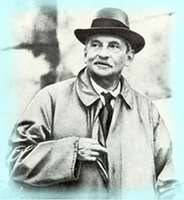 SIR ARTHUR EVANS
Knossos (sometimes spelt Knosos) is an ancient site. Occupied since 7000 BC by people's of the Neolithic Period.
The Minoans emerged around 2700 BC and flourished up to 1450 BC.
The term Minoan was coined by Sir Arthur Evans, a (British born) archaeologist, who excavated the site here at Knossos.
He named the people after the mythic King Minos. Knossos is the most important and most fascinating Minoan legacy in the world.
The Minoan civilisation is largely a mystery to scholars, and all we have learned about their culture is derived from the legacy they have left us: their beautiful art, architecture, and artifacts.
Knossos is one of three major Minoan sites, the others being at Phaestos and Malia.
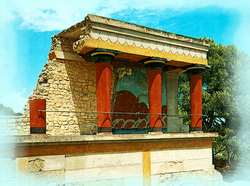 A RESTORED PART OF THE PALACE AT KNOSSOS
An interesting feature of this archaeological site is it's restoration.
Unlike most ancient sites, an attempt has been made to restore some monuments to what is believed to have been their original state.
The restorations were carried out by Arthur Evans. Criticism of this approach has been fended off by suggesting that such interventions were necessary to preserve the monuments as they became exposed.
It certainly does give a very good impression of what the monuments would have looked like and well worth a look.
The Monuments
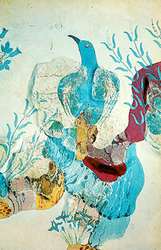 THE HOUSE OF FRESCOES, KNOSSOS
There are several monuments at Knossos:
The Palace of Knossos. Of all the Palaces this is the largest. With a central courtyard surrounded by 4 wings.
The Little Palace. A smaller palace west of the main
The Royal Villa. Thought to be the home of a religious aristocrat of the Minoan period or even a priest. It's north and east of the main palace.
House of the Frescoes. This is a smaller house with richly decorated frescoes on the walls.
Caravanserai. Thought to be a reception hall. It has painted walls and is equipped with baths, thought to be connected with healing.
The "Unexplored Mansion". This is located north and west of the main palace.
Temple Tomb. So called because it is thought that one of the last Kings of Knosses is buried here.
House of the High Priest. Lying about 300 m. south of the Caravanserai and connected to the Temple Tomb by a paved pathway.
The South Mansion. A three story Private civic house,
Villa of Dionysos. So called because of its fabulous mosaic depicting the Greek God. Thought to be a private house.
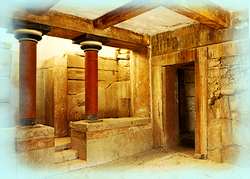 ROYAL VILLA KNOSSOS
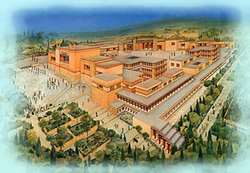 ARTISTIC IMPRESSION OF KNOSSOS
The Legends
Zeus, the greatest of all the Gods, gave birth to a son called Minos. It was Minos who became King of Knossos, Crete, and the Aegean.
It happened that King Minos gave birth to a son, Androgeus. Because of his strength and altheticism, Androgeus was sent to represent Crete in the Athenian Games.
His success at the games drew jealousy from the King of Athens who had Androgeus murdered.
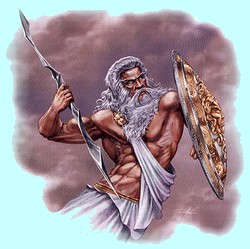 THE KING OF THE GODS
Zeus was a bit fed up about this and so dispatched a fleet to Athens seeking revenge for the murder of his son. He conquered the Greek city but instead of razing it to the ground he ordered that Athens send to Crete 7 men and 7 virgin women every year, to be sacrificed to the Minotaur who dwelt in the Labyrinth.
The King of Athens was upset with this arrangement and wanted to put an end to it. It happened that his son, Theseus, volunteered to be one of the 7 young men, so he could kill the fearsome Minotaur.
To signal the success of his mission, his father would see white sails on his ship replacing the black sails.
Now, Minos' daughter Ariadne happened to fall in love with Theseus, and so with her help, he was successful in killing the bull-like beast.
However, he was so excited with having found his true love and killing the Minotaur that he forgot to change the sails on his ship. When the King of Athens saw the black sails approaching, he killed himself in his grief, by throwing himself off the cliff into the sea.
Opening Times
Daily from 8.30am to 3.00pm
Contact
| Tel | +30 2810 231940, +30 2810 226470, +30 2810 226092, +30 2810 224630 |
| Fax | +30 2810 241515 |
| protocol@kgepka.culture.gr |
Current entrance fees:
| €6 | Full Admission |
| €3 | EU Citizens over 65, and students from outside the EU |
| FREE | Persons under 19 and university students |
There are a few free admission days to watch out for:
- The first Sunday of every month is FREE admission, except in the months of July, August and September, when the free day is the following day, Monday
- 6 March (in memory of Melina Mercouri)
- 5 June (International Environment Day)
- 18 April (International Monuments Day)
- 18 May (International Museums Day)
- The last weekend of September annually (European Heritage Days)
- Sundays in the period between 1 November and 31 March
- 27 September, International Tourism Day
Getting there
Knossos lies just 5 kilometres south-east of the Town.
You can catch a bus from Heraklion bus station (no.2) – it has "Knossos" on the front. By car, from the National Road follow signs to Knossos, on Route 99.
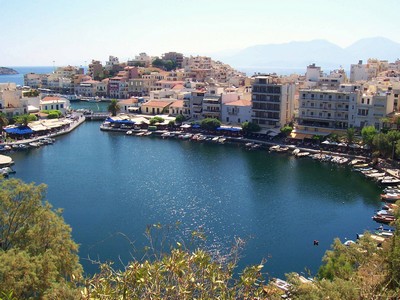
Just Some of the Reasons We Love Crete...
Did you love this page? Please share it with your friends!
© Copyright All Original Content 2006 - 2024 Completely-Crete.com. All
Rights Reserved. Reproduction in whole or in part without permission is
not permitted.
Click here to learn about developing your own money-generating website
from Solo Build It! - even with little or no web experience!